

Cracked Tooth Pain When Biting – Signs, Diagnosis and Treatment
A cracked tooth often hurts only when you bite on something in a certain way, or gives a sharp, short twinge with cold, and then the pain is gone. Because the crack is hairline-thin, it often does not show on an X-ray. The most reliable way to find it is a careful examination under a dental operating microscope, followed by treatment that holds the tooth together before the crack spreads.
By Dr. Kenil A. Lathia, MDS (Conservative Dentistry & Endodontics), Gujarat State Dental Council Reg. A-7754 · Ocean 32 – The Dentofacial Hub, Adajan, Surat · Last reviewed: November 2026
Book your consultation: https://ocean32care.in (online booking with your mobile number, no call needed) · Full treatment details: Diagnosis of Hidden Tooth Cracks in Surat
If you are searching for the best cracked tooth treatment in Surat, this guide explains, in plain words, how cracked tooth pain behaves, how a microscope-assisted endodontist finds the crack, and which treatment keeps the tooth for the long term.
What is a cracked tooth, and why does it hurt only sometimes?
A cracked tooth has a fine split running through the enamel into the dentine beneath. When you bite, the two sides of the crack flex apart slightly and press on the fluid inside the dentine, which sends a sharp signal to the nerve. When you release the bite, the sides close again and the pain stops. That on-off pattern is typical of a crack.
Dentists sometimes call this "cracked tooth syndrome". It is most common in back teeth (molars and premolars), especially teeth with large old fillings, because a big filling leaves thinner walls that flex more under chewing force.
What are the signs of a cracked tooth?
The classic sign is sharp pain on biting, often on one particular cusp or when you release the bite, together with brief sensitivity to cold or sweet. The pain is usually hard to locate: many people cannot say which tooth it is, upper or lower.
- A sharp "zing" when you bite on something small and hard, such as a seed, a grain of rice or a nut
- Pain when you let go of the bite (rebound pain)
- Short sensitivity to cold drinks or ice that settles within seconds
- You start chewing on the other side without thinking about it
- The pain comes and goes for weeks or months, and a normal check-up "found nothing"
Constant throbbing pain, pain that wakes you at night or swelling suggests the crack has already reached the nerve. That needs to be seen soon.
Why do teeth crack in the first place?
Teeth crack when chewing force is greater than what the remaining tooth structure can resist. The common reasons are large fillings that weaken the walls, night-time grinding or clenching, biting on hard objects, and teeth that have had a root canal treatment but were never given a crown or onlay.
- Large silver or composite fillings in molars
- Grinding or clenching, often during sleep or stress
- Chewing ice, supari (areca nut), hard candy or pen caps
- A root-treated back tooth left without cuspal coverage
- Sudden biting on a stone in food
Myth: "If the X-ray is clear, there is no crack." Fact: A hairline crack usually runs in a direction an X-ray cannot see. A clear X-ray does not rule out a crack; magnification, light and bite tests are what find it.
How is a cracked tooth diagnosed under a microscope?
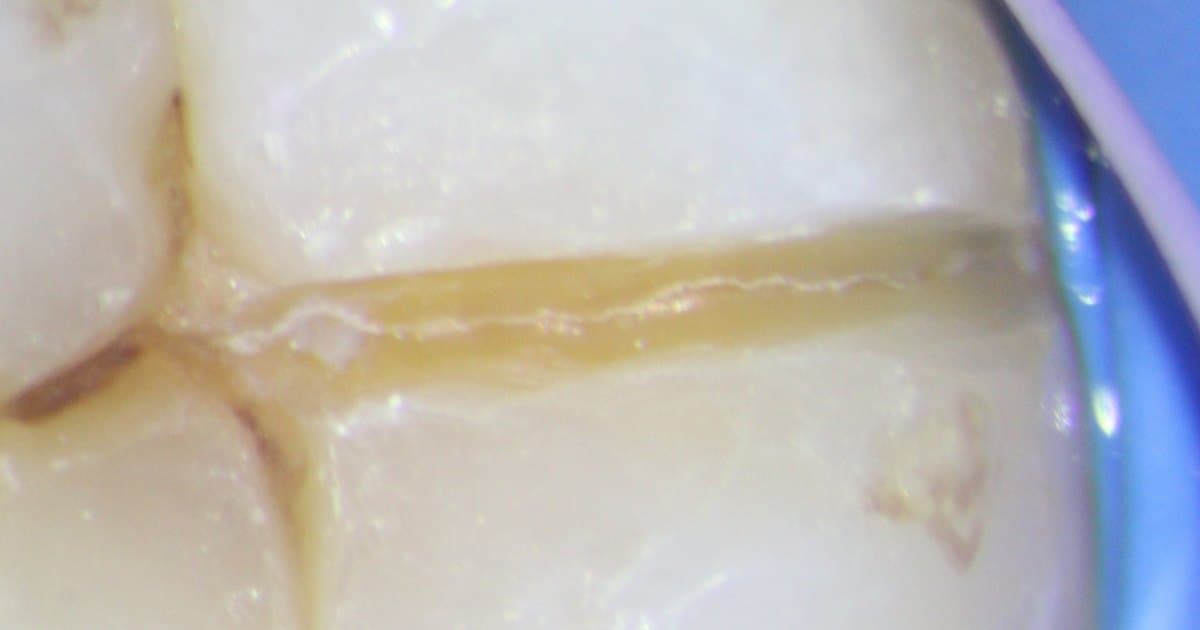
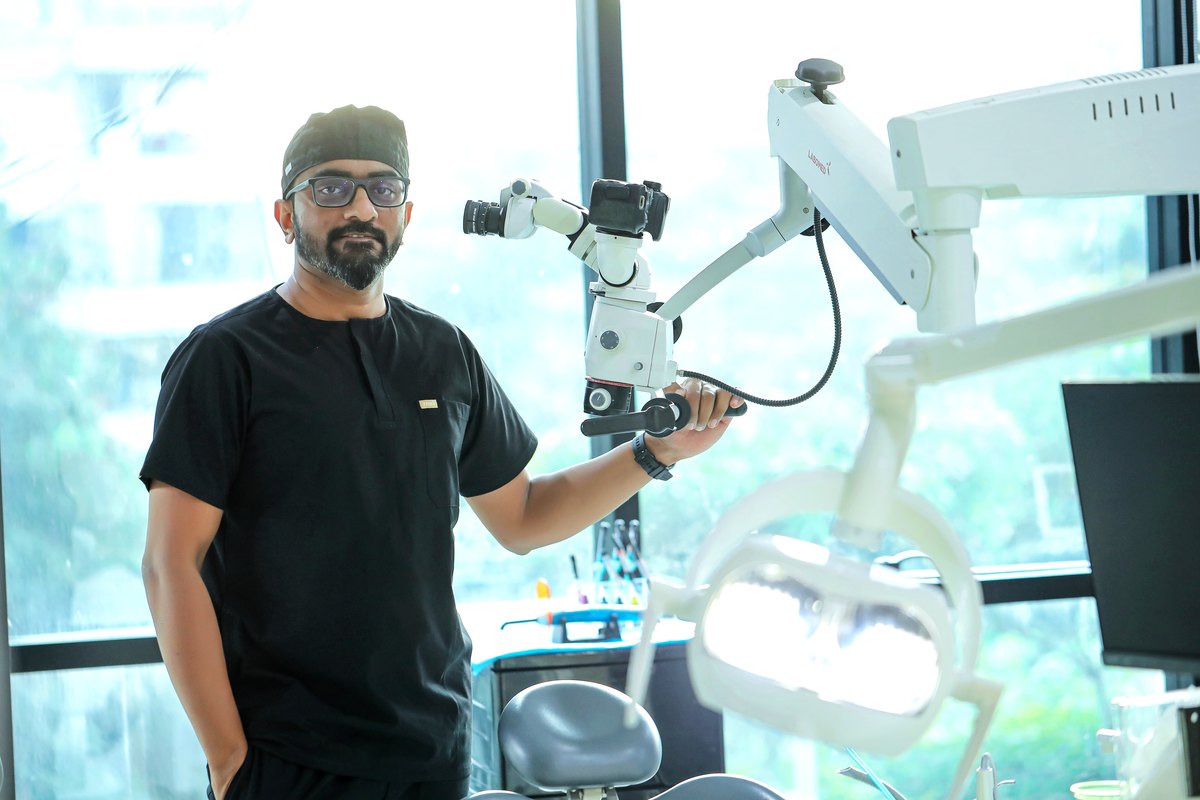
At Ocean 32 the tooth is examined under the Labomed Prima Pro surgical microscope with bright, focused light. Under high magnification a crack line that is invisible to the naked eye can be seen and traced: where it starts, which direction it runs, and whether it reaches the floor of the tooth or below the gum.
A full crack assessment usually combines several simple, non-invasive steps:
- Bite test: biting on a small tool, one cusp at a time, to find the exact cusp that hurts
- Cold test: to check whether the nerve is healthy, irritated or dying
- Microscope inspection: tracing the crack line, often after removing an old filling
- Dye or transillumination: a light passed through the tooth stops at a crack, which shows it clearly
- Gum probing: a narrow deep pocket next to one spot can mean the crack has gone down the root
- Digital X-ray: to check the bone and the root, even though the crack itself is rarely visible on it
The photo at the top of this article is an actual Ocean 32 patient's molar photographed through the microscope (shared with consent, unretouched): the fine wavy line across the tooth is the crack.
How is a cracked tooth treated?
Treatment depends on how deep the crack goes. A crack that stays in the crown of the tooth is held together with an onlay or crown that covers the cusps. If the crack has reached the nerve, a root canal treatment comes first. If it splits the root, the tooth usually cannot be saved and is replaced.
Crack limited to the enamel and dentine (most common)
- A bonded ceramic onlay or crown that wraps the cusps and stops them flexing apart
- At Ocean 32 this is often done in one visit with CEREC: Primescan digital scan, design, and milling in-house in the Primemill. See CAD-CAM inlays and onlays and CEREC Tessera crowns
Crack that has reached the nerve
- A microscopic root canal treatment, then a crown or onlay. Where suitable, this can be a single-sitting root canal with the crown made the same day
- For some root-treated molars, an endocrown is a conservative one-piece option
Split tooth or vertical root fracture
- When the crack divides the tooth into two pieces or runs down the root, the honest answer is usually removal, followed by a dental implant or bridge
Watch the case: fractured upper molar saved with re-attachment and root canal under the microscope (YouTube, Ocean 32).
Is treatment for a cracked tooth painful?
Treatment is designed to be painless: it is done under local anaesthesia, and the microscope lets the dentist remove only what is necessary. Most patients feel relief within days, because once the cusps are covered they can no longer flex, so the sharp biting pain stops.
Some temperature sensitivity can continue for a short time while the nerve settles. If the nerve was already badly irritated, the pain may not settle, and a root canal treatment is then advised.
What does good-quality crack treatment look like, compared with poor treatment?
Good treatment finds the crack, records how far it goes, and covers the cusps so the crack cannot open further. Poor treatment simply replaces the old filling, or does a root canal without a crown, and the crack keeps growing until the tooth splits.
Signs of good-quality care
- The crack is traced under magnification and explained to you, ideally with a photo
- Bite and cold tests decide whether the nerve needs treatment, not guesswork
- Cusps are covered with a bonded onlay or crown that fits precisely at the margins
- A night guard is advised if you grind your teeth
Warning signs of poor-quality care
- "Just a new filling" on a tooth with a known crack
- A root canal on a back tooth with no crown or onlay afterwards
- A temporary crown left for months, which can leak and let the crack collect bacteria
- Extraction suggested without first checking whether the crack can be held together
How quickly should a cracked tooth be treated?
As soon as it is diagnosed. A crack does not heal on its own; each chewing cycle can push it a little deeper. A crack that is held together early can usually be saved with an onlay or crown. Delay can turn the same tooth into a root canal case, or a split tooth that has to be removed.
Until you are seen, chew on the other side, avoid ice, nuts and hard foods, and do not test the tooth by biting on it.
Can I get a cracked tooth treated during a short visit to India?
Yes, in many cases. For patients visiting Surat from the UK, USA, Canada, Australia or Kenya, the diagnosis and a CEREC onlay or crown can often be completed in a single appointment, and a root canal plus crown can often be planned within one trip. Send your X-rays before you travel and book an online consultation first. Read more on dental treatment in Surat for NRIs.
About Ocean 32 – The Dentofacial Hub
Ocean 32 – The Dentofacial Hub is a dental clinic in Adajan, Surat, led by Dr. Kenil A. Lathia, MDS (Conservative Dentistry & Endodontics), Gujarat State Dental Council Reg. A-7754, with ILAMED fellowship training and about 10 years of practice since 2016. The clinic uses a Labomed Prima Pro surgical microscope for diagnosis and root canal treatment, and German CEREC CAD/CAM (Dentsply Sirona Primescan scanner and in-house Primemill) for single-visit crowns and onlays. Address: 302, 3rd Floor, Western Arena, Green City Road, Madhuvan Circle, above HDFC Bank, Adajan, Surat 395009.
Frequently asked questions
Can a cracked tooth heal on its own?
No. Enamel and dentine do not grow back across a crack. Sensitivity can quieten for a while, but the crack remains and can deepen. Covering the cusps with an onlay or crown is what stops it spreading.
Will a cracked tooth always need a root canal?
No. If the nerve tests healthy and the crack is limited to the crown, a bonded onlay or crown alone is often enough. A root canal is needed when the nerve is inflamed or dying.
Why did my dentist say "nothing is wrong" when it hurts to bite?
Hairline cracks are easy to miss with the naked eye and rarely show on X-rays. A bite test on each cusp and an examination under magnification usually find the cause.
Can a cracked front tooth be fixed?
Front teeth crack less often from chewing and more often from a fall or blow. Small craze lines in enamel are common and harmless; deeper cracks are treated with bonding, a veneer or a crown, depending on depth.
How long does a crown or onlay on a cracked tooth last?
It is long-lasting with good care: regular check-ups, cleaning between teeth and a night guard if you grind. The bigger risk is leaving the crack untreated.
Does it cost more to treat a crack late?
Usually yes, because an early crack may need only an onlay, while a late one may need a root canal, a crown or an implant. Fee ranges for each treatment are on the website's treatment pages, and you receive a transparent written estimate after examination.
Book a cracked tooth check at Ocean 32, Surat
If biting hurts and no one has found the reason, a microscope examination can usually give you a clear answer in one visit.
- Book online: https://ocean32care.in (mobile number only, no call needed)
- WhatsApp: +91 74900 43232 · Emergency: +91 74900 23232
- Visit: 302, 3rd Floor, Western Arena, Green City Road, Madhuvan Circle, above HDFC Bank, Adajan, Surat, Gujarat 395009 · Mon–Sat 10 AM–8 PM · Contact us
- Abroad? Online consultation on Google Meet, Mon–Sat 6–7 PM IST
Related reading: Teeth Sensitivity – 9 Causes, Home Care and When to See a Specialist.
Share this with someone who keeps chewing on one side because "one tooth hurts sometimes".
Book your consultation: https://ocean32care.in
General information only. Treatment depends on an individual examination.