

Conservative Dentistry in Surat – Saving More of Your Natural Teeth
Conservative dentistry is the branch of dentistry that repairs decayed, worn, cracked or broken teeth while keeping as much of the natural tooth as possible, choosing the smallest treatment that will last. It is for anyone with a cavity, a failing old filling, a chipped or cracked tooth, or a tooth they have been told may need removing, and at Ocean 32 – The Dentofacial Hub in Adajan, conservative dentistry in Surat is led by Dr. Kenil A. Lathia, whose MDS speciality is Conservative Dentistry & Endodontics.
Written and medically reviewed by Dr. Kenil A. Lathia, MDS (Conservative Dentistry & Endodontics), 15 years of clinical experience, GSDC Reg. A-7754 · Ocean 32 – The Dentofacial Hub. Last reviewed: November 2026.
Conservative dentistry in Surat: a real Ocean 32 case
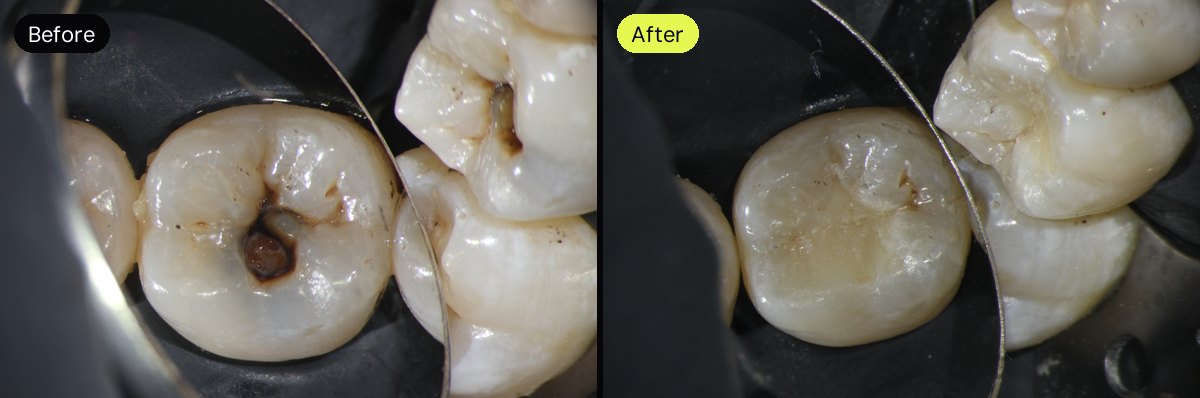
A deep cavity in a lower molar before, and the bonded composite restoration after, placed under rubber dam. Actual Ocean 32 patient, photographs with consent, unretouched. Results vary.What does conservative dentistry in Surat involve?
Enamel and dentine do not grow back, and each re-filling tends to leave a larger restoration and a weaker tooth. Tooth-saving dentistry slows that cycle. In practice, minimally invasive dentistry at Ocean 32 means:
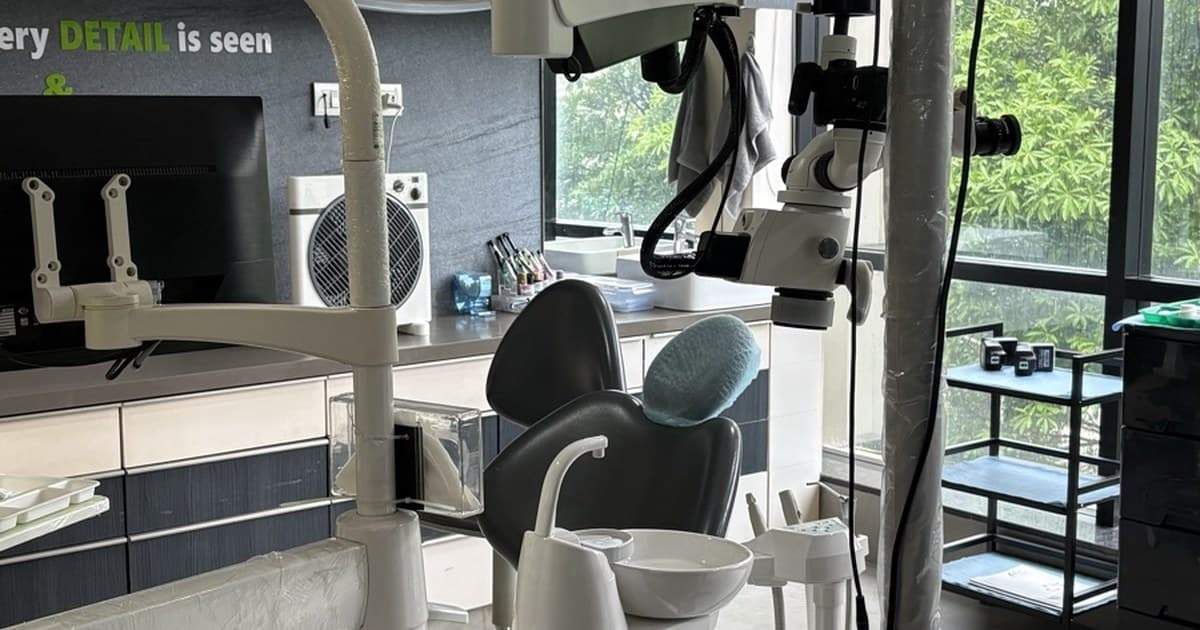
- See clearly before cutting. Digital X-rays and our Labomed Prima Pro operating microscope show the real extent of a problem, so we remove what is diseased and keep what is sound.
- Bond rather than cut for grip. Adhesive restorations bond to the tooth, so less healthy tooth is removed to hold them in place.
- Protect what remains. Weak cusps are covered before they break.
- Choose the smallest treatment that will last. A filling too small for the job can fail and cost the tooth more.
Root canal treatment belongs to the same speciality: once the nerve is affected, saving the tooth's own root is often the most conservative option.
Can decay be caught before it needs a big filling?
Often, yes. Early decay is a loss of minerals from the enamel, sometimes seen as a chalky white spot, and may be managed without drilling: better cleaning, fluoride, less frequent sugary snacking and monitoring. Once it breaks through into the softer dentine beneath, it usually needs a filling.
The hardest decay to spot starts between the teeth, just below where they touch. You cannot see it in a mirror, and it often causes no pain until the cavity is large. Digital X-rays at check-ups help show it while the repair is still small. Read more about interdental caries, the silent cavity between teeth.
What filling options will keep more of my tooth?
- Tooth-coloured fillings: a composite resin bonded to the tooth, built up in layers and shaded to match. Because it bonds, the cavity can follow the shape of the decay instead of being cut to a fixed outline. See tooth-coloured fillings.
- One-visit ceramic fillings: for larger cavities in back teeth, a ceramic restoration can be scanned with the Dentsply Sirona CEREC Primescan, milled on the CEREC Primemill and bonded in the same appointment where clinically appropriate. See one-visit ceramic fillings.
Bonding needs a clean, dry tooth, so we use rubber dam isolation where it can be placed.
When is an inlay or onlay better than a full crown?
A very wide filling can leave thin walls that flex and crack under chewing. If the outer walls are still thick and healthy, a ceramic inlay or onlay can restore the tooth without cutting it down for a crown.
- Inlay: fits inside the tooth, between the cusps.
- Onlay: covers one or more cusps as well, bracing a weakened tooth while keeping its healthy side walls.
- Crown: covers the whole visible tooth and needs the most reduction.
Where an onlay will do the job, we prefer it. Read about CAD/CAM inlays and onlays, or compare the options in inlay vs onlay vs crown.
What if my tooth is cracked?
Typical signs are a sharp pain on biting, especially on release, sensitivity to cold, and discomfort that comes and goes. Fine cracks often do not show on X-rays.
Diagnosis combines your symptoms, bite tests on individual cusps and examination under the operating microscope, sometimes after an old filling is removed. Management depends on where the crack runs:
- a crack within the crown of the tooth is usually held together with a bonded onlay or crown;
- if it has reached the nerve, root canal treatment is needed before the tooth is covered;
- a crack that splits the tooth or runs deep down the root usually means the tooth cannot be saved.
Cracks tend to grow, so early assessment gives the tooth a better chance. See diagnosis of hidden tooth cracks.
How is a badly broken tooth rebuilt?
When much of a tooth has broken away, the missing part is rebuilt with a core build-up so that an onlay or crown has something to hold on to. In a root-treated tooth where the core needs extra retention, a post placed a short way into one canal anchors it.
A post does not strengthen the root, and preparing space for it removes some tooth, so we use one when the tooth genuinely needs it. See post and core build-up.
Can a root canal save a tooth I was told to extract?
Often it can, when the tooth has a sound outlook. When decay, a crack or an injury lets bacteria reach the nerve, root canal treatment removes the infected or inflamed tissue and cleans and seals the canals, keeping your own root in the bone. At Ocean 32 it is carried out with rubber dam isolation under the operating microscope; see microscopic root canal treatment.
Whether saving the tooth is sensible depends on whether enough sound tooth remains to restore, the gum and bone are healthy, no crack runs into the root, the canals can be treated, and the tooth is useful in your bite. Our guide to root canal vs tooth extraction explains these trade-offs. A root-treated back tooth usually needs an onlay or crown to protect it; see crown after root canal.
Can front teeth be repaired without crowns?
Frequently. Chipped edges, worn tips, small gaps and uneven shapes can often be corrected by bonding tooth-coloured composite to the enamel, with little or no drilling of healthy tooth. Small gaps between front teeth can be closed by adding composite to the sides of the neighbouring teeth; see gap closure.
Larger gaps, crowding or bite problems may suit orthodontics better, such as SureSmile or Invisalign clear aligners, and composite can stain or chip over time, so it may need polishing or repair.
When is a crown, an extraction or an implant the better choice?
Keeping natural teeth is the aim, but not at any cost: a complex repair on a tooth with a poor outlook can take time and money and still fail. We will tell you plainly when a bigger step is sensible.
- A crown is advised when the walls are thin or missing, when cracks run around the tooth, or when a large core makes up much of it. We make CEREC Tessera, e.max and zirconia crowns, chosen to suit the tooth.
- An extraction may be advised when a crack splits the tooth or runs down the root, when decay reaches too far below the gum to be restored, or when the gum and bone support is too weak.
- An implant is one way to replace a tooth that is lost or has to be removed; see dental implants.
We explain each option, including what happens if you wait, and the decision is yours.
Who will treat my tooth?
Dr. Kenil A. Lathia, MDS in Conservative Dentistry & Endodontics, with 15 years of clinical experience, plans and carries out your treatment. Read more about Dr. Kenil A. Lathia, or see how magnification is used across treatments in microscopic dentistry.
I live abroad. Can I plan treatment before I travel?
Yes. NRIs and patients travelling to Surat can book an online video consultation on Google Meet and share any recent X-rays or reports. We can outline a likely plan, then confirm it after examining you in person. Single-visit ceramic restorations, where clinically appropriate, can reduce the appointments a short trip needs.
Patients visit from Adajan, Pal, Vesu, Rander, City Light and across Surat and South Gujarat.
How much will it cost?
Typical fee range at Ocean 32: Tooth-coloured filling: ₹4,000 – ₹6,000 per tooth. The exact fee depends on your tooth, the material and your plan, and is confirmed in your written estimate after examination.
The fee depends on the treatment your tooth needs, the size of the restoration and the material chosen. Your written estimate follows the examination.
Watch: a composite restoration under magnification
Watch more of our real procedures on the Ocean 32 YouTube channel, and book your consultation at ocean32care.in.Frequently asked questions
Is conservative dentistry just another name for fillings?
No. It covers fillings, but also inlays and onlays, cracked tooth care, build-ups, bonding and root canal treatment. The common aim is to keep as much natural tooth as possible with treatment that will last.
How can damaged teeth be restored conservatively?
By matching the repair to the damage: a bonded filling for a small cavity, an inlay or onlay when the walls are sound but a filling would be too large, and a crown when too little tooth remains. Root canal treatment can save a tooth whose nerve is affected.
Can a tooth with a large old filling still be saved?
Often, yes. We check for decay under the filling and for cracks in the walls. Where the walls are sound, an onlay may replace the old filling and protect the cusps without a full crown.
Does deep decay always mean a root canal?
No. If the nerve is healthy, the decay can sometimes be removed and the tooth sealed without root canal treatment. Your symptoms, tests and X-rays help decide this.
Will the treatment hurt?
Treatment is carried out under local anaesthetic where needed, and you can ask us to pause at any time. The tooth may feel tender for a few days afterwards; tell us if your bite feels high so we can adjust it.
How do I book an appointment?
To plan conservative dentistry in Surat, contact Ocean 32 – The Dentofacial Hub:
- WhatsApp: +91 74900 43232
- Book online: ocean32care.in
- Online video consultation: ₹1,000 on Google Meet, 6–7 PM Mon–Sat
- Clinic hours: Mon–Sat, 10 AM–8 PM
- Address: 302, 3rd Floor, Western Arena, Madhuvan Circle to Green City Road, above HDFC Bank, Adajan, Surat
- Dental emergency line: +91 74900 23232
Ocean 32 – The Dentofacial Hub opened in Adajan in 2016. Dr. Kenil A. Lathia holds an MDS in Conservative Dentistry & Endodontics and an ILAMED fellowship affiliated with the University of Greifswald.
General information, not a substitute for professional advice. Which treatment suits your tooth is decided after an examination.