

Inlay vs Onlay vs Crown – Which Restoration Saves More of Your Tooth?
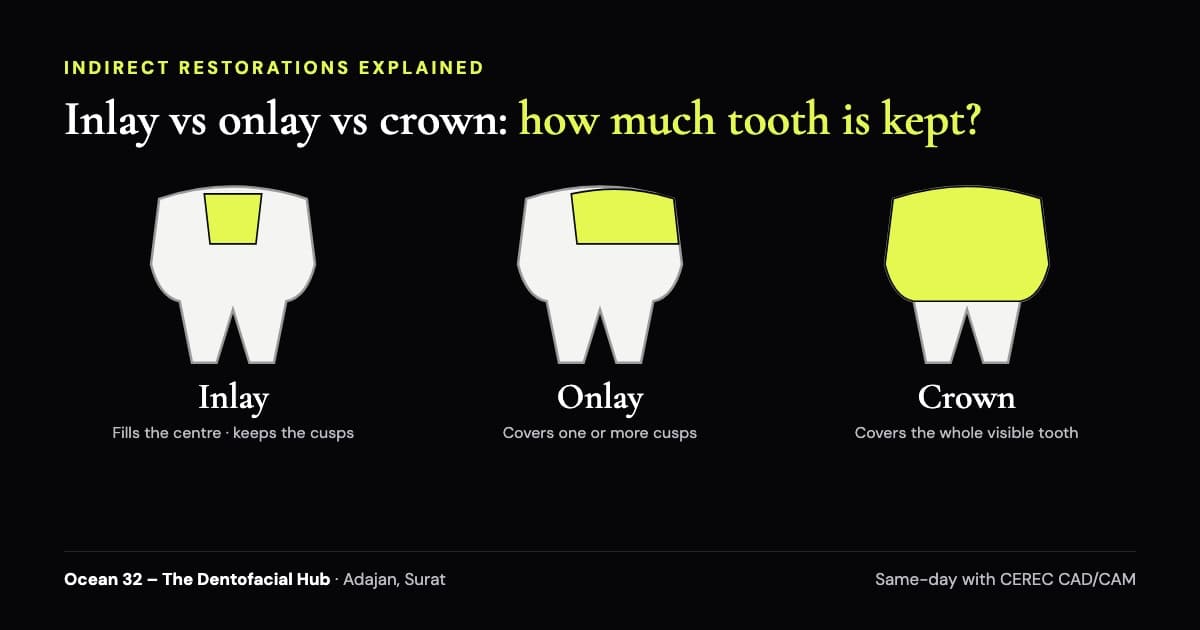
An inlay fills the centre of a damaged back tooth, an onlay also rebuilds one or more of its cusps, and a crown covers the whole visible tooth. The right choice is the smallest restoration that protects the tooth properly, because every millimetre of natural tooth you keep is a millimetre you never have to replace.
By Dr. Kenil A. Lathia, MDS (Conservative Dentistry & Endodontics), Gujarat State Dental Council Reg. A-7754 · Ocean 32 – The Dentofacial Hub, Adajan, Surat · Last reviewed: October 2026
What are indirect restorations?
An indirect restoration is made outside the mouth, milled or pressed from high-strength ceramic, and then bonded to the tooth. A filling, by contrast, is placed and shaped directly in the tooth. Indirect restorations generally handle chewing forces better than large fillings, which is why they are used when a tooth has lost a lot of structure.
There are four main types:
- Inlay: fills a cavity that sits within the cusps (the raised points) of a back tooth.
- Onlay: fills the cavity and also covers one or more cusps.
- Overlay: covers the whole biting surface while keeping the tooth's side walls.
- Crown: covers the entire visible part of the tooth.
Inlay vs onlay vs crown: how do they compare?
Inlay
- Tooth removed: the least.
- Best for: a medium-sized cavity or an old filling, where the surrounding walls are still strong.
- Protects the cusps: no.
Onlay or overlay
- Tooth removed: moderate.
- Best for: weak or cracked cusps, large old fillings, and back teeth after a root canal.
- Protects the cusps: yes.
Crown
- Tooth removed: the most.
- Best for: badly broken teeth, or when the colour or shape needs a major change.
- Protects the cusps: yes.
At Ocean 32 all three can be made with CEREC CAD/CAM in a single appointment. Learn more about CAD/CAM inlays and onlays in Surat.
When is a filling no longer enough?
Large fillings weaken the walls of a tooth over time. Signs that a back tooth may need an indirect restoration instead of another filling include:
- An old filling that covers more than about half of the biting surface.
- A cracked cusp, or sharp pain when you bite on something hard (see diagnosis of hidden tooth cracks).
- Repeated fillings in the same tooth.
- A back tooth that has had a root canal treatment.
Why choose an onlay instead of a crown?
To make room for a crown, the tooth has to be reduced on every side. An onlay is bonded to the healthy enamel that remains and replaces only what is missing. When the remaining walls are sound, an onlay can protect the tooth as well as a crown while keeping more natural structure. That leaves more options if the tooth ever needs treatment again.
A crown is still the right choice when too little healthy tooth is left to bond to, or when the appearance of the tooth needs to change significantly.
Do teeth need a crown after a root canal?
Back teeth usually need their cusps covered after a root canal, because the tooth is more likely to fracture. That cover can be an onlay or a crown, and onlays often preserve more tooth. Front teeth with little damage may only need a bonded filling. Read about same-day crowns after root canal treatment.
How is a single-visit CEREC restoration made?
- Preparation: decay or the old filling is removed and the tooth is shaped.
- Digital scan: an intraoral camera captures a 3D model. No putty impressions are needed.
- Design: the inlay, onlay or crown is designed on screen to fit your bite.
- Milling: the CEREC unit mills it from a solid ceramic block, such as CEREC Tessera or zirconia.
- Bonding: it is finished, then bonded in place in the same appointment.
Because there is no temporary restoration, single-visit treatment suits busy professionals and patients visiting Surat for a short stay. See one-visit CAD/CAM dentistry and CEREC Tessera crowns.
How long do ceramic inlays, onlays and crowns last?
How long they last depends on your bite, whether you grind your teeth, your oral hygiene and regular check-ups. If you grind your teeth, a night guard is the single best way to protect any ceramic restoration. Every restoration we place comes with a care plan.
Frequently asked questions
Is an onlay better than a crown?
Not always. An onlay keeps more natural tooth when the remaining walls are strong. A crown is better when the tooth is badly broken.
Can old silver (amalgam) fillings be replaced with ceramic inlays?
Yes. Large or failing amalgam fillings are one of the most common reasons for ceramic inlays and onlays.
Does getting an inlay or onlay hurt?
The procedure is done under local anaesthesia, much like a filling.
Are inlays and onlays tooth-coloured?
Yes. Ceramic restorations are shade-matched to your natural teeth.
Can I get an onlay in one visit?
Yes. With CEREC, the onlay is scanned, designed, milled and bonded in the same appointment.
Find out which restoration your tooth needs
Send an X-ray and a photo on WhatsApp to +91 74900 43232, or book a consultation with Dr. Kenil Lathia. Online consultations are ₹1,000, held on Google Meet from 6 to 7 PM IST, Monday to Saturday.
Ocean 32 – The Dentofacial Hub · 302, 3rd Floor, Western Arena, Green City Road, Madhuvan Circle, above HDFC Bank, Adajan, Surat, Gujarat 395009 · Mon–Sat 10 AM–8 PM
General information only. Your options depend on an individual examination.