

Bad Breath Causes – 10 Reasons, Home Fixes and When to See a Dentist
Most bad breath starts inside the mouth: bacteria living in plaque, tartar, a coated tongue, gum pockets, decay, or food trapped under an old filling or crown. Dry mouth, tobacco and some foods make it worse. Mouthwash only hides the smell for a short time; the lasting fix is finding the source and treating it.
Book your consultation: https://ocean32care.in (online booking with your mobile number, no call needed)
By Dr. Kenil A. Lathia, MDS (Conservative Dentistry & Endodontics), Gujarat State Dental Council Reg. A-7754 · Ocean 32 – The Dentofacial Hub, Adajan, Surat · Last reviewed: November 2026
Bad breath causes worry out of all proportion to the problem. People stop speaking close to others, keep chewing gum all day, or rinse with strong mouthwash several times a day and still feel the smell is there. At Ocean 32 – The Dentofacial Hub in Adajan, Surat, we see bad breath (halitosis) almost every week, and in most patients the cause is something we can see and treat in the mouth. This guide explains the ten common causes of bad breath, what you can do at home, and what a proper dental check for bad breath in Surat should include. If your gums bleed when you brush, read our guide to gum disease symptoms and treatment as well.
What causes bad breath?
Bad breath is caused mainly by bacteria that break down food debris, dead cells and proteins in the mouth and release sulphur gases with a strong smell. These bacteria collect where cleaning does not reach: on the back of the tongue, in tartar, between teeth, in gum pockets, in cavities and under the edges of old fillings and crowns.
That is why bad breath often returns within an hour of brushing. The surface is clean, but the hidden places are not. Finding which hidden place is responsible is the real work of treatment.
What are the 10 most common causes of bad breath?
These are the ten causes we find most often in our Surat practice. Many people have two or three at the same time, which is why fixing only one, such as the tongue, sometimes helps only partly. An examination with X-rays tells us which ones apply to you.
- Coated tongue: a white or yellow layer on the back of the tongue holds a large number of odour-causing bacteria.
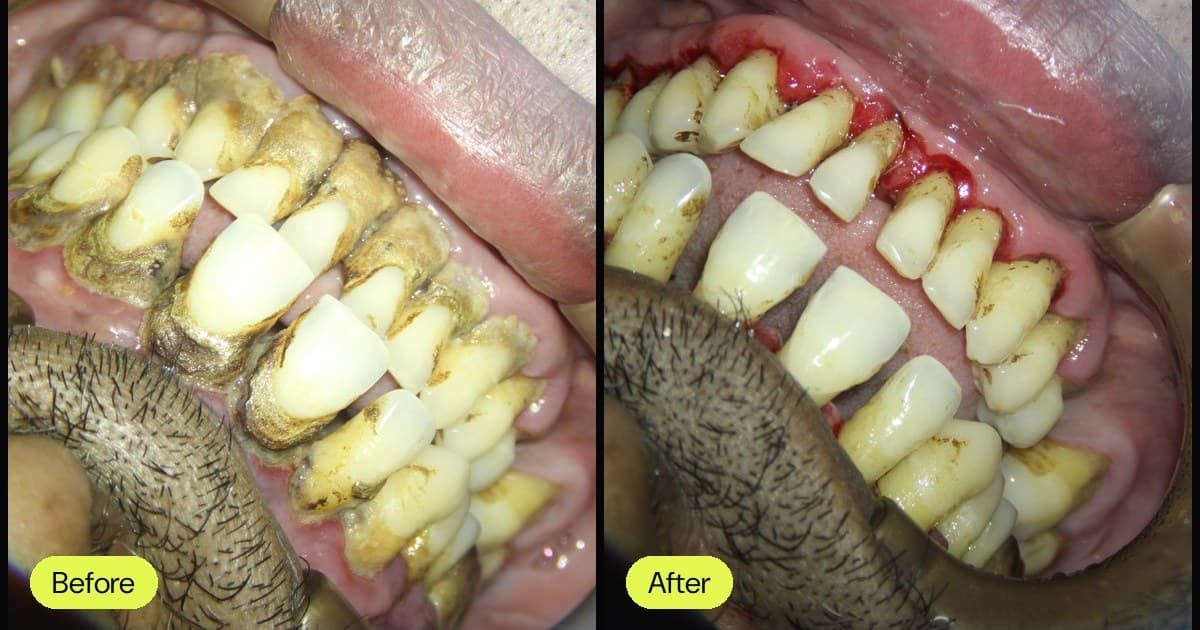
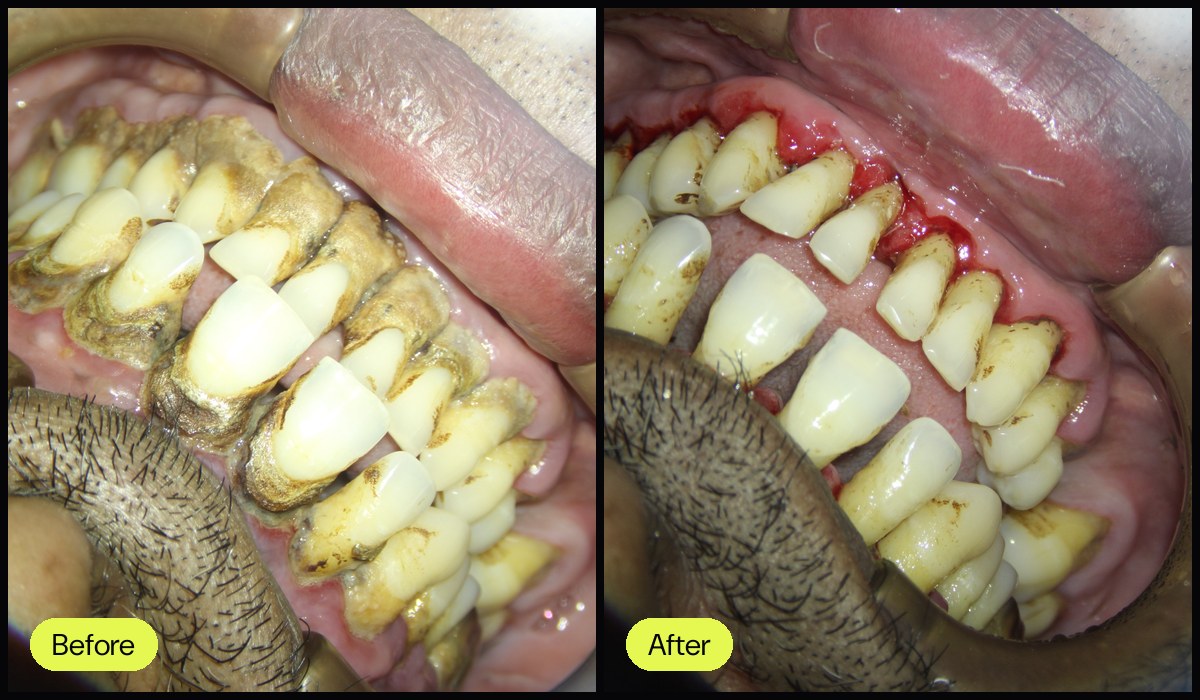
- Plaque and tartar: soft plaque hardens into tartar (calculus) that a toothbrush cannot remove, and bacteria live in and under it.
- Gum disease: inflamed gums form pockets around teeth where bacteria grow without air. Bleeding gums and bad breath often come together.
- Tooth decay: a deep cavity traps food and bacteria. See the stages of tooth decay.
- Leaking old fillings and crowns: a gap at the edge of an old restoration collects food and gives a bad taste around one tooth.
- Food packing between teeth: a gap or a poorly shaped filling lets fibres of food get stuck every meal.
- Wisdom tooth flap: a partly erupted wisdom tooth with gum over it traps food and can become swollen and smelly.
- Dry mouth: saliva washes bacteria away. Mouth breathing, long fasting, low water intake and some medicines reduce it, which is also why morning breath happens.
- Tobacco, gutka, paan and smoking: they leave their own smell, dry the mouth and increase gum disease.
- Dentures, aligners and retainers not cleaned well: plaque grows on them just as it does on teeth.
Strong foods such as onion and garlic cause short-lived breath odour that passes on its own. Less often, bad breath comes from the nose, sinuses, tonsils, acid reflux or a medical condition such as uncontrolled diabetes. When the mouth is healthy and the smell remains, we advise a check with your physician or ENT specialist.
How do I know if I have bad breath?
It is hard to judge your own breath because the nose gets used to it. Simple checks help: lick the inside of your wrist, let it dry for a few seconds and smell it, or look at the back of your tongue in a mirror for a thick coating. The most honest test is to ask someone you trust.
Signs that point to a dental source include bleeding gums, a bad taste in one area, food sticking in the same place every day, a broken or dark old filling, swelling around a back tooth, or loose teeth.
Myth or fact: does mouthwash cure bad breath?
Myth: "A strong mouthwash will cure bad breath." Fact: mouthwash masks the smell for a short time but does not remove tartar, clean gum pockets, fill a cavity or seal a leaking crown. Alcohol-based mouthwashes can even dry the mouth. Use a mouthwash only as your dentist advises, not as a replacement for treatment.
A second common myth is that bad breath always comes from the stomach. In most people the source is in the mouth, which is good news, because it can usually be treated in the dental chair.
What can I do at home to stop bad breath?
Home care controls the bacteria that cause bad breath. Brush twice a day for two minutes with a soft brush and fluoride toothpaste, clean the tongue from back to front every morning, clean between teeth daily with floss or interdental brushes, drink enough water, and stop tobacco. Give it two weeks; if the smell remains, see a dentist.
- Use a tongue cleaner gently; the back third of the tongue matters most.
- Clean between teeth before brushing at night.
- Rinse after meals and after tea or coffee if you cannot brush.
- Soak and brush dentures, aligners and retainers daily, and keep dentures out at night if your dentist advises.
- Chew sugar-free gum after meals to increase saliva, not to cover the smell.
How does a dentist treat bad breath?
A dentist treats bad breath by removing its source. That usually means professional scaling and polishing, gum treatment for pockets, filling decay, replacing leaking fillings or crowns, removing or treating a problem wisdom tooth, and giving you a home-care plan. Once the source is gone, the smell usually improves within days.
- Scaling and polishing: removes tartar above and below the gumline. See teeth cleaning and polishing in Surat; fee ranges are on our teeth cleaning and scaling fees page.
- Gum treatment: deep cleaning of pockets and follow-up checks. See gum treatment in Surat. If gums are sore, cleaning can be done painlessly under local anaesthesia.
- Replacing leaking restorations: an old crown with an open edge can be replaced with a precisely fitting ceramic crown. With CEREC CAD/CAM and a Primescan intraoral scanner, many single crowns are designed, milled and fitted the same day. See single-visit zirconia crowns.
- Infected teeth: a tooth with an abscess or a draining gum boil can give a constant bad taste. It may need microscopic root canal treatment or removal.
- Wisdom teeth: a repeatedly swollen, food-trapping wisdom tooth may need simple or surgical extraction.
What does good-quality treatment for bad breath look like?
Good-quality treatment finds every source, not just the obvious one. It includes a full examination with digital X-rays, gum pocket measurement, tongue assessment, a check of every old filling and crown edge, and a written plan. Treatment that is only a quick polish often leaves the real cause behind, so the smell returns.
Signs of thorough treatment
- Tartar removed above and below the gumline, not only on the front surfaces
- Gum pockets measured and recorded, with a re-check date
- Old fillings and crowns checked with X-rays and magnification
- Root canal treated teeth protected with a well-sealed crown
- Clear home-care instructions, including tongue and between-teeth cleaning
Signs something may have been missed
- Only a quick polish, with no X-rays and no gum check
- A crown with a dark line or catching edge at the gum, left as it is
- A root canal treated tooth left without a crown for months, letting leakage in
- A temporary filling or crown kept for a long time and leaking
- Bad breath blamed on the stomach without a full dental check first
At Ocean 32, examinations are carried out by Dr. Kenil A. Lathia, MDS in Conservative Dentistry and Endodontics, with a Labomed Prima Pro surgical microscope to check the edges of fillings and crowns closely. The clinic has served patients in Surat since 2016. Read more on dental check-ups with digital X-rays.
Can I fix bad breath during a short visit to Surat from abroad?
Yes, in most cases. Scaling, gum cleaning, fillings and many single crowns can be completed within one short visit, and same-day CEREC crowns help when time is limited. Deeper gum disease needs a re-check after a few weeks, which can be planned with your dentist at home or on your next trip.
If you live in the UK, USA, Canada, Australia or Kenya, you can book an online consultation on Google Meet, Monday to Saturday, 6–7 PM IST, and send recent X-rays in advance. More on planning is on our dental tourism in Surat page.
Frequently asked questions
Why do I have bad breath even after brushing?
Brushing cleans the tooth surfaces, but bacteria remain on the back of the tongue, under tartar, in gum pockets, in cavities and under leaking fillings or crowns. If the smell returns soon after brushing, one of these hidden sources is usually responsible and needs a dental examination.
Can gum disease cause bad breath?
Yes. Gum disease is one of the most common causes. Bacteria in gum pockets produce strong-smelling gases, and bleeding gums add to it. Scaling, gum treatment and good home care usually improve the breath clearly.
Is morning bad breath normal?
Mild morning breath is normal because saliva flow drops during sleep. It should disappear after brushing, cleaning the tongue and drinking water. Breath that stays bad through the day is not normal morning breath.
Can a tooth cause bad breath on one side?
Yes. A bad taste or smell near one tooth often comes from a deep cavity, a leaking crown, food packing, an abscess or a wisdom tooth flap. A focused examination with an X-ray of that area usually finds it.
When should I see a dentist for bad breath?
See a dentist if bad breath lasts more than two weeks despite good home care, or comes with bleeding gums, swelling, a bad taste, loose teeth or pain.
Does teeth cleaning damage enamel?
No. Professional scaling removes tartar, not enamel. Teeth may feel slightly sensitive for a few days as the cleaned surfaces are exposed to air. Read our teeth sensitivity guide if that continues.
Book a bad breath check at Ocean 32, Surat
Book your consultation: https://ocean32care.in. You can also message us on WhatsApp +91 74900 43232 or contact us. Patients abroad can book an online consultation on Google Meet, Monday to Saturday, 6–7 PM IST.
Ocean 32 – The Dentofacial Hub
302, 3rd Floor, Western Arena, Green City Road, Madhuvan Circle, above HDFC Bank, Adajan, Surat, Gujarat 395009
Monday to Saturday, 10 AM–8 PM · Emergency +91 74900 23232
Share this with someone who keeps chewing mints and still worries about their breath.
General information only. Treatment depends on an individual examination.