

Root Canal Treatment in India for NRIs: Microscope Endodontics Guide
If you live abroad and need a root canal, you can plan it around your trip to India and often finish it, crown included, within one stay. The key is to get a diagnosis online before you fly, and to choose a specialist who treats under a surgical microscope so the tooth is cleaned completely the first time.
By Dr. Kenil A. Lathia, MDS (Conservative Dentistry & Endodontics), Gujarat State Dental Council Reg. A-7754 · Ocean 32 – The Dentofacial Hub, Adajan, Surat · Last reviewed: October 2026
Why do so many NRIs plan root canals for their India visit?
Patients who visit us from the UK, USA, Canada, Australia and Kenya usually mention three things: specialist appointments at home can take weeks, out-of-pocket fees for root canals and crowns are high, and they want to be treated by someone who understands their language and their family's dental history.
A trip home is a natural window. Without a plan, though, it can turn into a rushed appointment and an unfinished tooth on the flight back. This guide explains how to avoid that.
What is a microscope root canal?
A microscope root canal is root canal treatment performed under a surgical operating microscope. The microscope gives the endodontist a magnified, brightly lit view inside the tooth. At Ocean 32 we use a Labomed Prima Pro surgical microscope.
Under magnification the dentist can:
- Find extra canals. Many molars have canals that are hard to see with the naked eye, and an untreated canal is a common reason root canals fail.
- Spot cracks that change the diagnosis or the treatment plan.
- Negotiate calcified canals, which narrow with age or old trauma.
- Remove old filling material and broken instruments during retreatment.
The microscope doesn't replace skill. It removes guesswork, which is why it is standard equipment in specialist endodontic practice. Read more about microscopic root canal treatment in Surat.
Can my root canal be done in one visit?
Often yes, but not always. A single-sitting root canal is suitable when:
- The tooth isn't severely infected or swollen at the time of treatment.
- The canals can be fully cleaned, shaped and dried in one session.
- Your symptoms and medical history support it.
When there is an active infection, a short gap between visits for an antibacterial dressing is sometimes the safer choice. We'll tell you honestly which applies to you, ideally at your online consultation, before you book flights.
Does the tooth need a crown afterwards?
Back teeth that have had a root canal usually need cusp coverage (an onlay or a crown) to protect them from fracture. This is where travel plans often fall apart: a lab-made crown can take days, leaving you with a temporary.
At Ocean 32 we use German CEREC CAD/CAM to design, mill and fit a ceramic onlay or crown in the same appointment. In many cases this happens on the same day as the root canal or the next day, so you fly home with the tooth finished. See same-day crowns after root canal and CAD/CAM inlays and onlays.
What if I had a root canal before and it failed?
A tooth that hurts, swells or shows a dark area on an X-ray after a previous root canal can often be saved with root canal retreatment. Under the microscope the old filling is removed, the canals are re-cleaned (including any that were missed), and the tooth is sealed again. When retreatment isn't possible, a small surgical procedure called micro-apical surgery (apicoectomy) may be an option.
How do I plan this around my trip?
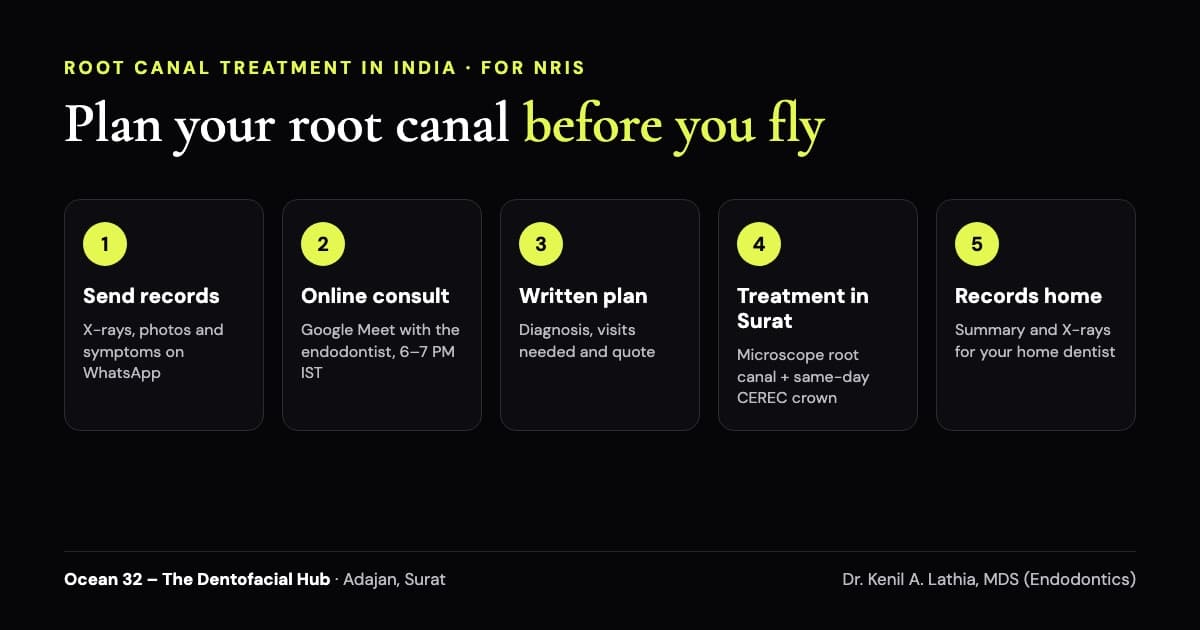
- Send your records (2–4 weeks before you fly): WhatsApp recent X-rays, photos and your symptoms to +91 74900 43232.
- Online consultation (1–3 weeks before): a ₹1,000 Google Meet consultation with Dr. Lathia, Monday to Saturday, 6–7 PM IST.
- Written plan: diagnosis, options, number of visits and a written quote.
- Treatment during your stay: the root canal, then a CEREC onlay or crown where suitable.
- Records to take home: a treatment summary and X-rays for your dentist at home.
6–7 PM IST in your time zone:
- London: 12:30–1:30 PM (GMT)
- New York and Toronto: 7:30–8:30 AM (EST)
- Nairobi: 3:30–4:30 PM (EAT)
- Sydney and Melbourne: 11:30 PM–12:30 AM (AEDT)
What should I check before choosing a dental clinic in India?
- The dentist's state dental council registration. Ours is Gujarat State Dental Council Reg. A-7754.
- Who actually performs your root canal: a specialist endodontist or a general dentist.
- A written plan and quote before you travel.
- The sterilisation protocols and the materials used.
- Records you can take home, and a clear aftercare plan.
More on travelling for treatment: dental tourism in Surat.
Frequently asked questions
Is a root canal painful?
With modern local anaesthesia, most patients feel pressure rather than pain. The pain people associate with root canals usually comes from the infection before treatment.
Can I fly after a root canal?
Most patients can fly within a day or two of a routine root canal. If you had significant swelling, we'll advise you individually.
How many days should I keep free in Surat?
For a single tooth with a same-day CEREC restoration, often one to three days of appointments. Complex cases or several teeth need more. Your consultation gives you a realistic number.
Will my dentist abroad accept work done in India?
We provide a full treatment summary and X-rays so your regular dentist can continue your care.
What if something feels wrong after I fly home?
Message us on WhatsApp. We review photos and X-rays remotely and advise on next steps, including coordinating with a local dentist if needed.
Plan your root canal before you fly
WhatsApp +91 74900 43232 or book a ₹1,000 online consultation with Dr. Kenil Lathia.
Ocean 32 – The Dentofacial Hub · 302, 3rd Floor, Western Arena, Green City Road, Madhuvan Circle, above HDFC Bank, Adajan, Surat, Gujarat 395009 · Mon–Sat 10 AM–8 PM
This article is general information, not a diagnosis. Treatment depends on an individual examination.