

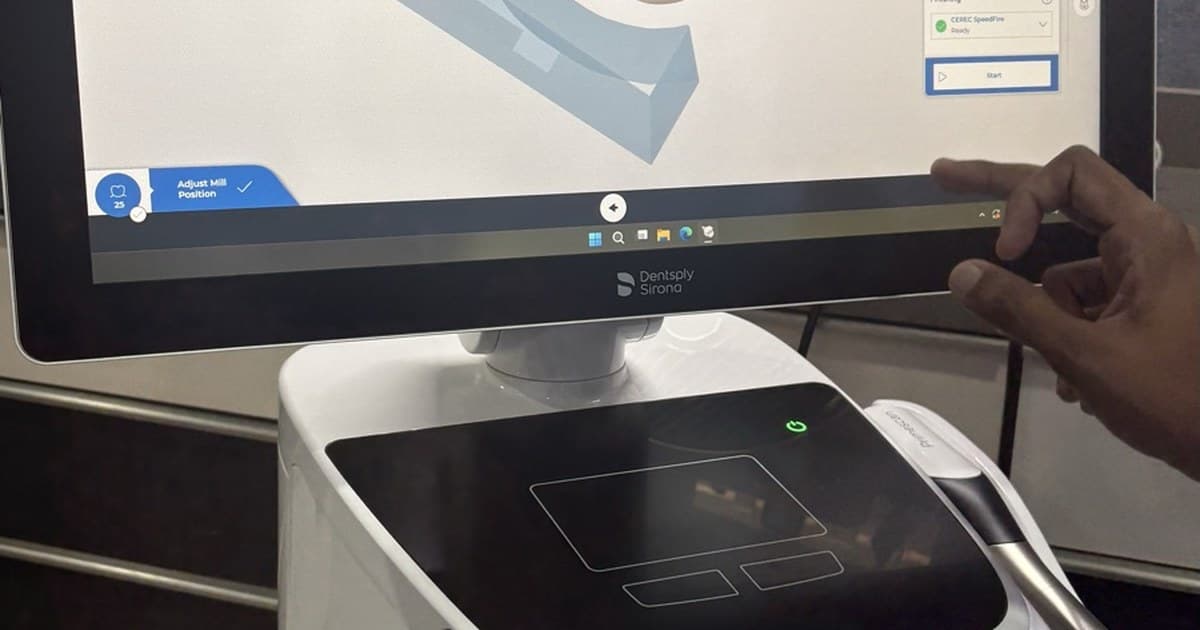
Best Dental Implants in Surat – Guided Digital Planning and Surgical Guides
Guided dental implants in Surat are implants placed with the help of a surgical guide: the implant's position is planned digitally in advance from 3D imaging of the jaw and a Primescan digital scan, and the guide transfers that plan to your mouth. Guided placement is for adults replacing one or more missing teeth, and it is particularly helpful where bone is limited, several implants are needed, a front tooth is being replaced or a full-arch plan is underway.
Written and medically reviewed by Dr. Kenil A. Lathia, MDS (Conservative Dentistry & Endodontics), 15 years of clinical experience, GSDC Reg. A-7754 · Ocean 32 – The Dentofacial Hub. Last reviewed: November 2026.
This page explains the guided method specifically. Ocean 32 offers guided implant planning and placement with premium implant systems and digital workflows. For general information about implants, see our main page on dental implants in Surat.
Guided dental implants in Surat: a real Ocean 32 case
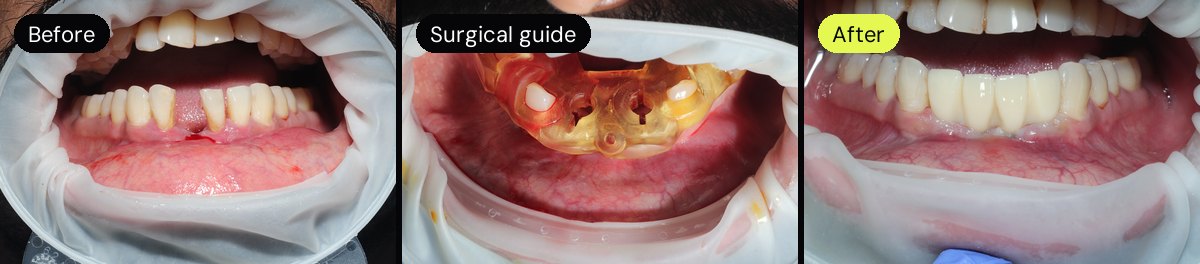
Missing lower front teeth before; the 3D-printed surgical guide in place during surgery; the final teeth after. Actual Ocean 32 patient, photographs with consent, unretouched. Results vary.What is guided implant placement?
In freehand placement, the implant is planned from X-rays and then positioned by hand during surgery, with its final angle and depth judged at the chair. In guided implant surgery, those decisions are made in advance, on screen.
Two sets of records are combined. 3D imaging of the jaw shows the height and width of the bone and where the nerves and sinuses lie. A digital scan with the CEREC Primescan intraoral scanner records your teeth, gums and bite. Together they form a digital model of your mouth, on which the position, angle and depth of each implant are planned.
A surgical guide is then made to fit over your teeth or gums. During placement, the guide directs the drills so the implant goes where it was planned. You may also see this described as computer-guided implant placement or digital implant planning.
Why plan an implant digitally before surgery?
An implant needs to sit in enough bone, clear of important structures, and in the right place for the tooth that will be fixed to it. Digital implant planning lets all three be considered together before the day of surgery.
- Bone: the implant can be positioned within the bone you have, and areas that may need grafting can be identified beforehand.
- Nerves and sinuses: in the lower jaw, the nerve that gives feeling to the lip and chin runs through the bone; in the upper back jaw, the sinus sits above the roots. The plan keeps the implant clear of both.
- The final tooth: the crown is designed on screen before the implant is positioned beneath it. This is called restoration-driven planning: the shape of the tooth and your bite decide where the implant goes, rather than the implant deciding what the tooth can look like.
- Often smaller openings: because the position is already known, the implant can often be placed through a smaller opening in the gum. Whether this suits you depends on your bone and gum.
- A plan you can see: you see on screen where each implant will go, and why, before the guide is made.
Who benefits from guided implant surgery?
A guide is most useful where there is little room for error or where several things need to line up:
- Limited bone. When the ridge is narrow or short, planning helps make good use of the bone that is there and shows whether bone grafting is needed beforehand.
- Several implants. When two or more implants support a bridge, they need to be spaced and angled to work together. See multiple tooth implants.
- Front teeth. Where appearance matters, the implant's position affects how the gum and crown look beside your natural teeth. For one missing tooth, see single tooth implant.
- Full-arch plans. When a whole arch is being replaced, for example with All-on-4 full-arch implants, the implant positions are planned around the bone and the new teeth together. See full mouth rehabilitation.
Still deciding whether an implant is right for you? Our comparison of dental implants vs bridges explains how the two options differ.
Can my natural tooth be saved instead?
Before planning any implant, we check whether the tooth can be kept. A tooth with deep decay, an infection or a failed root canal may still be treatable, and a healthy natural tooth is worth keeping where that is realistic.
This page is reviewed by Dr. Kenil A. Lathia, an endodontist whose field is saving teeth through root canal treatment. Where a tooth is restorable, microscopic root canal treatment may be advised in place of extraction. Read more about saving your natural tooth before choosing an implant.
An implant is usually recommended when a tooth cannot be saved predictably: for example, when a crack runs deep into the root, too little sound tooth remains, or the bone around it is badly damaged.
How do guided dental implants in Surat work at Ocean 32?
- Consultation. We examine your mouth, review your medical history, take digital X-rays and check whether any tooth involved can be saved. We also discuss whether a guide adds value in your case.
- 3D imaging and Primescan scan. 3D imaging of the jaw is arranged where needed. The CEREC Primescan records your teeth, gums and bite digitally, without impression trays or putty. See digital impressions.
- Digital plan, reviewed with you. The imaging and scan are combined, the planned crown is designed, and the position, angle and depth of the implant are set beneath it. We go through the plan with you on screen before anything is made.
- Surgical guide made. A guide matching your plan is made to fit your mouth.
- Placement under local anaesthetic. The area is numbed, the guide is seated, and the implant is placed through it as planned.
- Healing. The implant is left to bond with the bone. Healing time varies with your bone, the site and whether grafting was done, and we review progress before moving to the next stage.
- The crown. Once the implant has healed, the crown is made. In suitable cases, an implant crown can be designed and milled with CEREC at Ocean 32; see single-visit implant crown.
Where a tooth still has to be removed, the timing of extraction, grafting and implant placement is decided case by case.
Does a surgical guide remove every risk?
No. A guide helps carry a careful plan into your mouth, but it cannot change your biology or remove every risk of surgery. Its limits are worth knowing:
- Some cases need bone grafting beforehand. If the 3D imaging shows too little bone, a bone graft may be advised before or at the time of placement. Bone grafting is offered at Ocean 32.
- The plan may change during surgery. Images are a close guide to the bone, not a perfect copy of it. If the bone differs from what the images showed, the implant size or position may be adjusted, a graft added, or placement postponed.
- Usual surgical risks remain. Swelling, bruising, discomfort and infection can still occur, and, rarely, problems involving a nerve or sinus. We explain these before you agree to treatment.
- Healing depends on you as well. Smoking, poorly controlled diabetes, gum disease and difficulty cleaning around the implant can all affect how it heals and how it does over time.
- Not every case needs a guide. For some straightforward single implants with ample bone, careful planning without a guide may be suitable. We recommend a guide when it adds value for your case, not by default.
I live abroad. How are the visits planned?
For NRIs and patients travelling to Surat, begin with an online video consultation on Google Meet and share any X-rays, 3D imaging or reports you already have. Implant treatment needs healing time between stages, so it is not usually completed in one short trip. Instead, the visits are planned around your trips, with placement on one visit and the crown on a later visit once healing allows. The plan is confirmed after examining you in person. See dental tourism in Surat.
Patients visit from Adajan, Pal, Vesu, Rander, City Light and across Surat and South Gujarat.
How much will guided implant treatment cost?
Typical fee range at Ocean 32: Guided dental implant: ₹45,000 – ₹1 lakh per tooth. The exact fee depends on your tooth, the material and your plan, and is confirmed in your written estimate after examination.
The fee depends on the number of implants, whether bone grafting is needed, the imaging and surgical guide required, and the type of crown or bridge. Your written estimate follows the examination.
Frequently asked questions
Does guided implant placement hurt?
The area is numbed with local anaesthetic before the implant is placed. Afterwards, some tenderness or swelling is common; we give you aftercare instructions, and you can contact us if it does not settle.
Do I need 3D imaging for a guided implant?
Yes. The digital plan is built from 3D imaging of the jaw together with a Primescan digital scan of your teeth and gums. If you already have recent 3D imaging, bring it; otherwise we arrange it where needed.
Does guided placement mean a smaller cut?
Often, but not always. Where the bone and gum allow, the implant can be placed through a small opening in the gum. When the bone needs to be seen directly or grafted, the gum is opened in the usual way.
Can the plan change during surgery?
Yes. If the bone differs from what the images showed, the implant size or position may be adjusted, a bone graft added, or placement postponed. We discuss this possibility with you beforehand.
Does every implant need a surgical guide?
No. A guide helps most where bone is limited, nerves or sinuses are close, several implants must work together, or appearance matters. For some straightforward single implants, careful planning without a guide may be suitable.
Can the crown on a guided implant be made with CEREC?
Sometimes. Once the implant has healed, an implant crown can in suitable cases be designed and milled with CEREC at Ocean 32. Whether this suits your implant is decided at the crown stage.
How do I book an appointment?
To plan guided dental implants in Surat, contact Ocean 32 – The Dentofacial Hub:
- WhatsApp: +91 74900 43232
- Book online: ocean32care.in
- Online video consultation: ₹1,000 on Google Meet, 6–7 PM Mon–Sat
- Clinic hours: Mon–Sat, 10 AM–8 PM
- Address: 302, 3rd Floor, Western Arena, Madhuvan Circle to Green City Road, above HDFC Bank, Adajan, Surat
- Dental emergency line: +91 74900 23232
Ocean 32 – The Dentofacial Hub opened in Adajan in 2016. Dr. Kenil A. Lathia holds an MDS in Conservative Dentistry & Endodontics and has 15 years of clinical experience.
General information, not a substitute for professional advice. Whether guided implant placement suits you is decided after an examination and 3D imaging.